
Loading
Loading
We use strictly necessary cookies to run this site, and analytics cookies to understand how it's used. See our Privacy Policy for details.
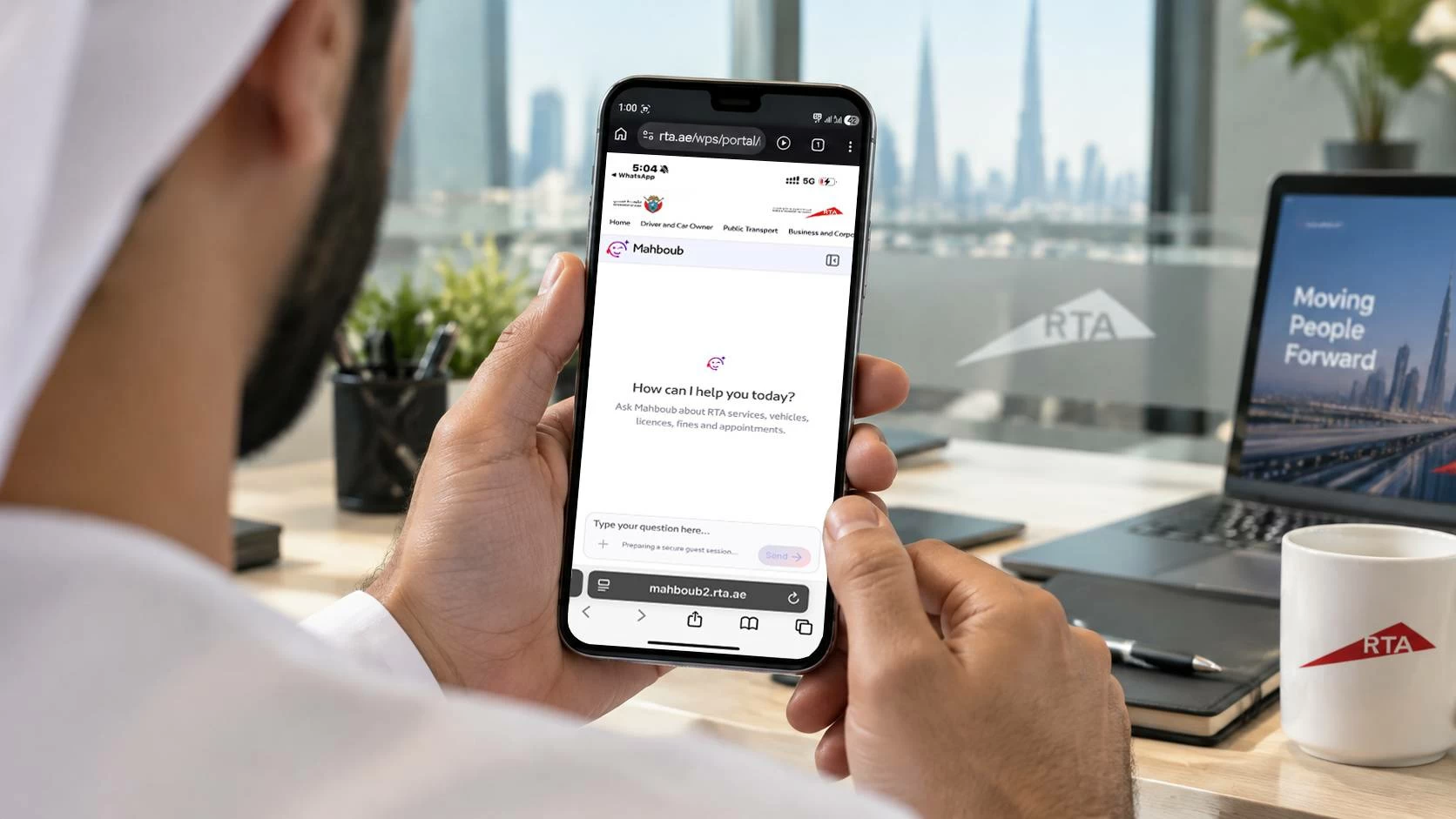
Dubai: Dubai’s Roads and Transport Authority (RTA) has upgraded Mahboub, its virtual assistant, using Agentic AI technology to simplify the customer journey and facilitate the completion of RTA services through a unified conversational experience.
Summary
The enhanced version is being prepared for public rollout as part of RTA’s Artificial Intelligence Strategy 2030. Mahboub uses Agentic AI to coordinate and execute services involving interconnected steps, in addition to the information and services it currently provides. Depending on each customer’s request, the system activates specialised Agentic AI to coordinate and carry out the required procedures, such as paying vehicle fines and then renewing vehicle registration, according to the customer’s needs.
The system enables customers to complete these procedures within a single conversation. The process includes using the UAE PASS digital identity for verification and the Dubai Sadad platform for payment. The initial scope focuses on vehicle licensing services, including vehicle registration renewal, vehicle fines payment, a clearance certificate issuance and number plate reservations renewal.
Mahboub supports Arabic and English, with language models fine-tuned to suit the local context. Mahboub aims to reduce the need for customers to switch between pages and channels, as well as the number of steps required to complete transactions. It is also expected to reduce the time and effort involved in accessing services.
Development is being carried out in accordance with RTA’s established governance and cybersecurity procedures. The enhancement reflects RTA’s drive to develop leading, customer-centric digital services and reinforce Dubai’s standing with the aim of establishing the emirate as a global leader in trusted, smart government services.
KazaSec's take
AI-related security incidents are a genuinely new category, prompt injection, model manipulation, and data leakage through an LLM integration don't map cleanly onto traditional application security testing, and are worth assessing deliberately rather than assuming existing controls already cover them.
Coverage details
We've archived 10 other articles touching the same topic (uae, /22312099265/emirates247/uae) , see the full security news archive.
Relevant from KazaSec
More coverage on this topic
We help organizations find and fix the gaps before they make headlines.