
Loading
Loading
We use strictly necessary cookies to run this site, and analytics cookies to understand how it's used. See our Privacy Policy for details.
By: Zilola Sayfiddinova Alisher Introduction In the twenty-first century, technological development has become one of the most influential factors shaping human civilization.
Summary
Among the numerous innovations that have transformed modern society, Artificial Intelligence (AI) occupies a particularly important position. It is rapidly changing the way people live, work, communicate, learn, and interact with the world around them. Artificial Intelligence is no longer a concept associated only with science fiction or advanced scientific laboratories; it has become an essential part of everyday life.
Artificial Intelligence can be defined as the ability of computer systems and machines to perform tasks that traditionally require human intelligence. These tasks include learning from experience, analyzing information, recognizing images and speech, understanding languages, solving problems, and making decisions. Through technologies such as machine learning, deep learning, natural language processing, and computer vision, AI systems are becoming increasingly sophisticated and capable of performing complex operations.
Today, artificial intelligence is used in various fields, including education, medicine, science, agriculture, industry, transportation, business, and communication. Its rapid development creates new opportunities for economic growth, scientific discoveries, and social progress. At the same time, it raises important questions concerning employment, privacy, security, ethics, and human responsibility.
The purpose of this article is to examine the role of artificial intelligence in the modern world, explore its practical applications in different areas of human activity, identify its major advantages and challenges, and discuss its potential influence on the future of society. Main Part Artificial Intelligence in Education Education is one of the fields in which artificial intelligence has created significant opportunities for improvement and innovation. Traditional educational systems are gradually integrating digital technologies to make the learning process more effective, accessible, and student-centered.
AI-powered educational platforms can analyze students’ learning progress, identify their strengths and weaknesses, and provide personalized learning materials. This approach allows students to study at their own pace and receive additional support in areas where they experience difficulties. Intelligent tutoring systems, online learning applications, automated assessment tools, and digital assistants are examples of how artificial intelligence is transforming education.
Artificial intelligence also provides valuable opportunities for teachers. Educators can use AI tools to prepare lesson plans, develop educational exercises, create presentations, generate assessment questions, and organize interactive learning activities. These technologies help reduce the time spent on routine tasks and allow teachers to focus more on students’ individual needs, creative thinking, and intellectual development.
Moreover, AI-based translation and language-learning applications make foreign language education more accessible. Students can practice pronunciation, improve vocabulary, receive grammatical explanations, and communicate with intelligent virtual assistants. Such opportunities are particularly important in an increasingly interconnected world where multilingual communication has become essential.
However, artificial intelligence should not replace teachers or reduce the importance of human interaction in education. Teachers play an irreplaceable role in developing students’ moral values, social skills, creativity, independent thinking, and emotional intelligence. Therefore, the most effective educational approach is to combine modern AI technologies with professional teaching methods and human guidance.
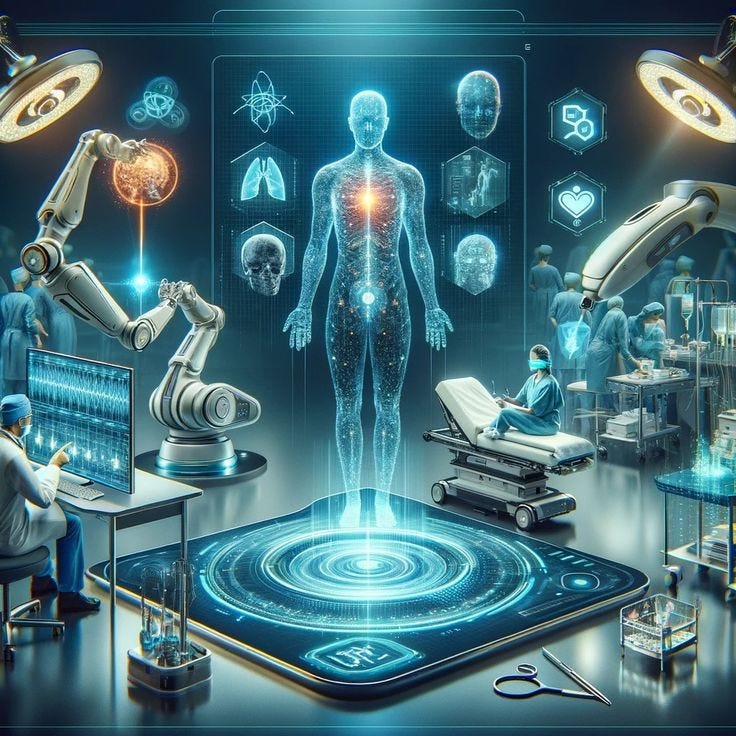
The Role of Artificial Intelligence in Healthcare Healthcare is another important sector experiencing remarkable changes due to artificial intelligence. Medical professionals and researchers increasingly use AI systems to analyze medical data, identify diseases, improve diagnostic procedures, and support treatment decisions. One of the most valuable applications of AI in medicine is medical image analysis.
Intelligent systems can examine X-rays, MRI scans, CT images, and other medical examinations to help specialists identify abnormalities. These technologies can assist in detecting certain diseases at earlier stages, allowing patients to receive timely medical attention. Artificial intelligence also contributes to the development of personalized medicine.
By analyzing medical histories, genetic information, and other health-related data, AI systems can help researchers and healthcare professionals understand individual patient needs and explore more suitable treatment approaches. Furthermore, AI technologies are being used in pharmaceutical research, where they can help scientists analyze chemical compounds, identify potential drug candidates, and accelerate certain stages of medicine development. In hospitals, intelligent systems can support patient management, appointment scheduling, and the organization of medical information.
Despite these advantages, AI cannot independently replace the professional knowledge, experience, and ethical responsibility of doctors. Medical decisions require careful human evaluation, especially when patients’ lives and well-being are involved. Therefore, artificial intelligence should function as a supportive instrument that improves healthcare services under appropriate professional supervision.
Artificial Intelligence in Business and the Economy The influence of artificial intelligence on business and economic development is becoming increasingly significant. Modern companies use AI technologies to improve productivity, reduce operational costs, analyze market trends, and provide better customer services. One of the major advantages of AI in business is its ability to process enormous amounts of information within a short period.
Companies can use these analytical capabilities to understand consumer behavior, predict market demands, identify business opportunities, and make more informed decisions. In the banking sector, artificial intelligence helps identify unusual financial transactions, detect potential fraud, and improve customer support services. Chatbots and virtual assistants can answer frequently asked questions and provide information to customers at any time of the day.
Manufacturing industries also benefit from AI-powered automation. Intelligent machines and robots can perform repetitive tasks with high precision, monitor production processes, and identify technical problems. This improves efficiency, reduces certain human errors, and contributes to the development of modern industrial systems.
However, the expansion of automation also creates challenges for the labor market. Some traditional occupations may change or become less common as machines take over routine tasks. Consequently, employees need to develop new professional skills, improve their digital literacy, and adapt to changing economic conditions.
In this context, lifelong learning and professional development are becoming increasingly important. Artificial Intelligence in Science and Research Scientific research has entered a new stage of development with the introduction of artificial intelligence. Researchers use intelligent systems to analyze complex datasets, identify patterns, formulate hypotheses, and explore scientific questions that may be difficult to investigate using traditional methods alone.
KazaSec's take
AI-related security incidents are a genuinely new category, prompt injection, model manipulation, and data leakage through an LLM integration don't map cleanly onto traditional application security testing, and are worth assessing deliberately rather than assuming existing controls already cover them.
Coverage details
We've archived 218 other articles touching the same topic (tech) , see the full security news archive.
Related security advisories
Relevant from KazaSec
More coverage on this topic
We help organizations find and fix the gaps before they make headlines.