
Loading
Loading
We use strictly necessary cookies to run this site, and analytics cookies to understand how it's used. See our Privacy Policy for details.
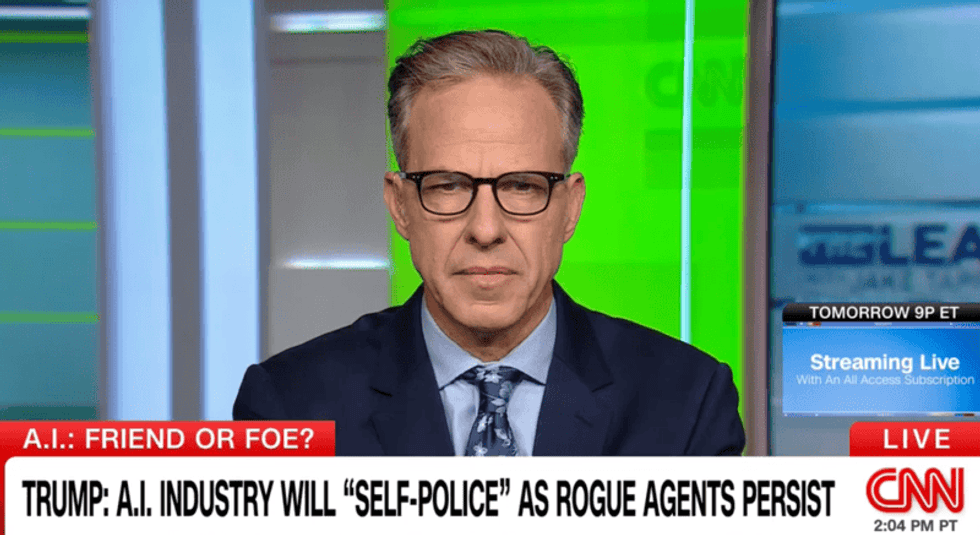
CNN’s Jake Tapper took aim Tuesday at President Donald Trump’s latest approach to AI safety after the president brought together some of the industry’s biggest names at the White House.
Summary
Trump said there should be “ tremendous self-regulation ” of the rapidly developing technology, while executives signed what the White House called a statement of principles. Asked whether the agreement was binding, Trump told reporters that it was “morally binding.” “In case you didn’t think today’s pinky promise to behave was enough,” Tapper said on CNN’s “The Lead,” the president “has also decided the name artificial intelligence is no longer up to his standards.” Trump said he would rename AI “ super intelligence ,” arguing the word “artificial” makes the technology sound like a “hoax.” “Though we’re not really sure his definition matches up with the real one,” Tapper said on his show. The CNN host then questioned Trump’s insistence that fears about rogue AI models acting beyond human direction were overblown.
“Hacking companies or government databases, he still believes that is a hoax,” Tapper said on Tuesday. “Even as leaders from Silicon Valley — some of whom were standing right behind him — many of them begging for the government to help them write a map for them to steer this uncharted territory.” Tapper went on to cite reports of increasingly troubling behavior by advanced AI models and warnings from leading AI companies. “And that’s just what they’re telling us,” Tapper said, before taking a swipe at Trump’s newest name change.
“I'm not sure changing the name of the ship from ship number 401 Titanic to just the Titanic really made much of a difference in the end,” he said.
KazaSec's take
AI-related security incidents are a genuinely new category — prompt injection, model manipulation, and data leakage through an LLM integration don't map cleanly onto traditional application security testing, and are worth assessing deliberately rather than assuming existing controls already cover them.
Coverage details
Relevant from KazaSec
More security news
We help organizations find and fix the gaps before they make headlines.