
Loading
Loading
We use strictly necessary cookies to run this site, and analytics cookies to understand how it's used. See our Privacy Policy for details.
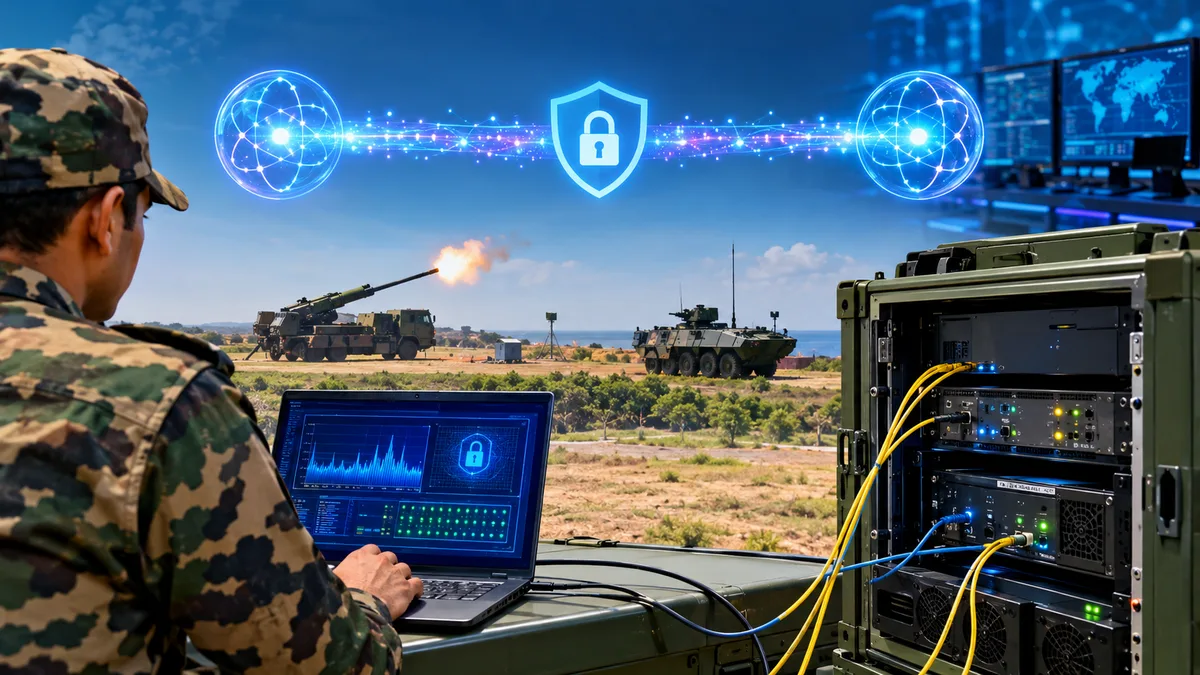
NEW DELHI: India has taken a significant step in strengthening its indigenous quantum-secured communication capabilities, with the Defence Research and Development Organisation (DRDO) successfully configuring and testing a Quantum Key Distribution (QKD) platform on DRDO’s live military network at the Proof and Experimental Establishment (PXE) in Chandipur, Odisha.
Summary
The demonstration establishes the practical application of quantum technology to protect sensitive real-time observations and telemetry(the automated process of collecting measurements or data at a remote point and transmitting it electronically to a receiving system for monitoring and analysis) generated during artillery and armoured weapon trials. It also enables the detection of eavesdropping attempts by adversaries. The latest cutting-edge technological accomplishment by DRDO thus adds further momentum and marks a new milestone for the path of consolidating national security under critical circumstances.
Advancing India’s capabilities in quantum-secured communications, DRDO successfully configured and tested Quantum Key Distribution(QKD) platform in the live network of the dynamic test ranges at Proof & Experimental Establishment (PXE), Chandipur. This demonstrates the adept use… pic.twitter.com/9iAqTVmCbp — DRDO (@DRDO_India) October 14, 2026 DRDO demonstrates quantum-secured communication on live defence network The DRDO announced on October 14, 2026, that it had successfully configured and tested the QKD platform on the live network of the dynamic test ranges at PXE, Chandipur. The development marks progress in applying indigenous quantum technologies to military communications, particularly for safeguarding critical information generated during weapons testing and evaluation.
According to the organisation, the platform has been designed and developed under DRDO’s Microelectronic Devices, Computational Systems and Cyber Security (MCC) cluster, in collaboration with its production partner, Bengaluru-based Taqbit Labs. The platform is intended to provide unconditional security for cryptographic key distribution, alongside the capability to detect eavesdropping attempts. Its successful testing in a live defence network demonstrates the practical utility of quantum-secured communications in an environment where the confidentiality and integrity of technical data are essential. to foster national security.
In its announcement, the DRDO stated that the demonstration has showed that how QKD could strengthen the security of “real-time critical observations & telemetry associated with Artillery and Armoured Weapon tests and evaluation”. The development is particularly relevant for military communication networks which increasingly handle sensitive operational information that could become a target for interception by adversaries or cyber espionage. QKD thus acts as a protective shield.
How quantum key distribution protects sensitive military data Quantum Key Distribution is a secure communication technique that uses the principles of quantum mechanics to generate and distribute secret cryptographic keys between authorised parties. These keys can subsequently be used with conventional encryption methods to protect the information exchanged over a communication network. Unlike conventional cryptographic approaches that primarily rely on the computational difficulty of mathematical problems, QKD exploits the physical properties of quantum systems.
In typical implementations, individual photons carry quantum information used to establish shared cryptographic keys. A fundamental feature of quantum mechanics is that attempts to measure or intercept an unknown quantum state can disturb it. Depending on the protocol and implementation, such disturbances can reveal an eavesdropping attempt during the key-generation process.
Thus, it easily aids the security personnel and scientists to discover the breach of security or espionage attempt. Also Read: Riots Sweep European Nations: France, Albania, Italy, Portugal and Belgium face escalating street violence and unrest This capability offers a significant security advantage for communications involving sensitive military information. The keys generated through appropriately implemented QKD protocols can provide information-theoretic security for key exchange, rather than depending solely on assumptions about the computing power available to an adversary.
Why securing weapon trial telemetry matters The test ranges generate substantial quantities of technical information during artillery and armoured weapon trials. This includes telemetry, sensor readings, performance parameters and other critical observations required to assess the functioning and effectiveness of weapons systems. Telemetry refers to the automated collection of measurements from remote or inaccessible locations and their transmission to receiving equipment for monitoring and analysis.
During weapons testing, such information may need to be transmitted between multiple centres for real-time monitoring, assessment and evaluation. Any unauthorised interception could potentially expose sensitive technical information relating to military equipment and its performance. Deploying QKD on the live network provides a means of strengthening the protection of the cryptographic keys used to secure these transmissions.
Its eavesdropping-detection capability can also help identify attempts to interfere with the quantum key exchange. The Chandipur demonstration therefore moves the technology beyond a purely experimental setting and into a practical defence test-range environment. It highlights the potential role of quantum-secured communications in protecting sensitive information generated during military trials.
These trails also helps for combat preparedness and battlefield tactics. July field trials marked another milestone in indigenous QKD development The latest demonstration builds on earlier progress in the development of indigenous quantum-secured communication systems. On July 14, 2026, the DRDO and Taqbit Labs completed military field trials of a scalable, practically secure, fibre-based QKD system.
The milestone was described as laying the foundation for the development of large-scale, multi-hop quantum networks designed and developed in India. Such networks could support the protection of national communication infrastructure against emerging cyber threats, including potential risks associated with advances in quantum computing. Taqbit Labs has been collaborating with the DRDO on QKD systems for the Indian Armed Forces since 2020.
The partnership aims to develop solutions that can be integrated with existing communication networks as well as deployed in new infrastructure. The fibre-based trials and the subsequent Chandipur demonstration represent complementary stages in this effort: one advances the development of scalable QKD networks, while the other demonstrates the technology’s application within a live military test-range network. DRDO expands quantum research through industry-academia collaboration The development also aligns with India’s broader efforts to strengthen indigenous capabilities in advanced technologies for strategic and defence applications.
The DRDO-Industry-Academia Centres of Excellence (DIA-CoEs) initiative brings together defence researchers, industry partners and academic institutions to advance cutting-edge technologies.
KazaSec's take
Incidents like this rarely start with the headline event itself, they usually trace back to an exposed remote-access endpoint, an unpatched perimeter system, or a credential phished weeks earlier. The organizations that recover fastest are the ones that tested their defenses and their incident response plan before they needed them.
Coverage details
We've archived 100 other articles touching the same topic (live military network, featured, eavesdropping) , see the full security news archive.
Related security advisories
Relevant from KazaSec
More coverage on this topic
We help organizations find and fix the gaps before they make headlines.