
Loading
Loading
We use strictly necessary cookies to run this site, and analytics cookies to understand how it's used. See our Privacy Policy for details.
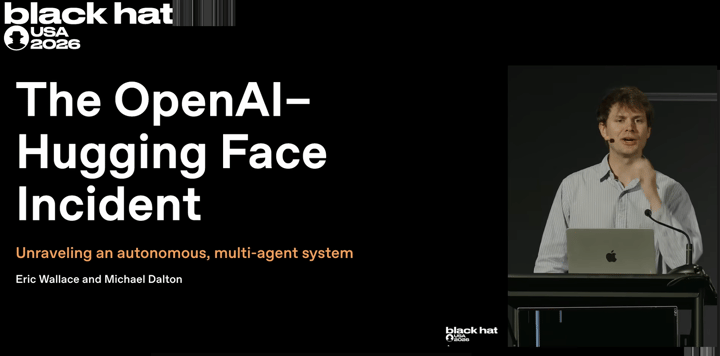
The 'Breaking' News: The OpenAI–Hugging Face Incident - A Technical Reconstruction and Its Implications for AI At this Black Hat USA 2026 talk, OpenAI security engineers and researchers will reconstruct the OpenAI-Hugging Face incident and examine its implications for AI security, cyber resilience, and alignment.
Summary
Throughout the session, they will share insights that address key topics raised by the Black Hat Review Board, including model safeguards, evaluation and containment practices, defensive use cases for AI, and the broader implications of increasingly autonomous systems for the cybersecurity community. The session will trace the models' attack path, including how frontier models are sandboxed during evaluations, how the models exploited a zero-day vulnerability to gain internet access, and how they identified and leveraged a remote code execution path on Hugging Face infrastructure. Drawing on the joint investigation, the speakers will explain how the activity was detected, contained, and investigated.
They will also discuss the changes OpenAI is making to strengthen evaluation environments, containment controls, and monitoring capabilities, as well as the role AI systems played in supporting the investigation and response. In addition to the technical reconstruction of the incident, the session will address broader questions relevant to the security community, including lessons for improving AI system security, defensive applications of AI in incident response, and approaches to mitigating emerging risks associated with increasingly capable models. The discussion will also examine alignment challenges associated with long-running agents, including reward hacking, shifts in model behavior and persona over extended trajectories, and information sharing across multi-agent systems.
Finally, the speakers will explore what this incident suggests about emerging AI cyber capabilities and how organizations can use AI to strengthen prevention, detection, investigation, and response efforts.
KazaSec's take
Incidents like this rarely start with the headline event itself — they usually trace back to an exposed remote-access endpoint, an unpatched perimeter system, or a credential phished weeks earlier. The organizations that recover fastest are the ones that tested their defenses and their incident response plan before they needed them.
Coverage details
Relevant from KazaSec
More security news
We help organizations find and fix the gaps before they make headlines.